VR Chemistry Labs in Junior High Chemistry: Safe, Visible, and Forgiving Science
Junior high chemistry introduces students to real hazards — open flames, toxic gases, corrosive chemicals. VR Chemistry Labs solve three classic classroom problems at once: dangerous experiments become safe, invisible reactions become visible, and fleeting demonstrations become repeatable.
Junior high chemistry is the first science course in which students genuinely handle hazard: open flames, toxic gases, explosive mixtures, and corrosive chemicals all appear within the first year. Teachers know the dilemma well. The experiments that excite students most are precisely the ones that are hardest to run, hardest to see, and hardest to repeat. A gas preparation experiment that can explode if the apparatus is wrong, a diffusion process that no eye can follow, a combustion that finishes in three seconds: each one challenges the classroom in a different way. VR Chemistry Labs address all three problems at once, and the examples below come directly from a classroom-grade chemistry course built for this purpose.
Making Dangerous Experiments Safe
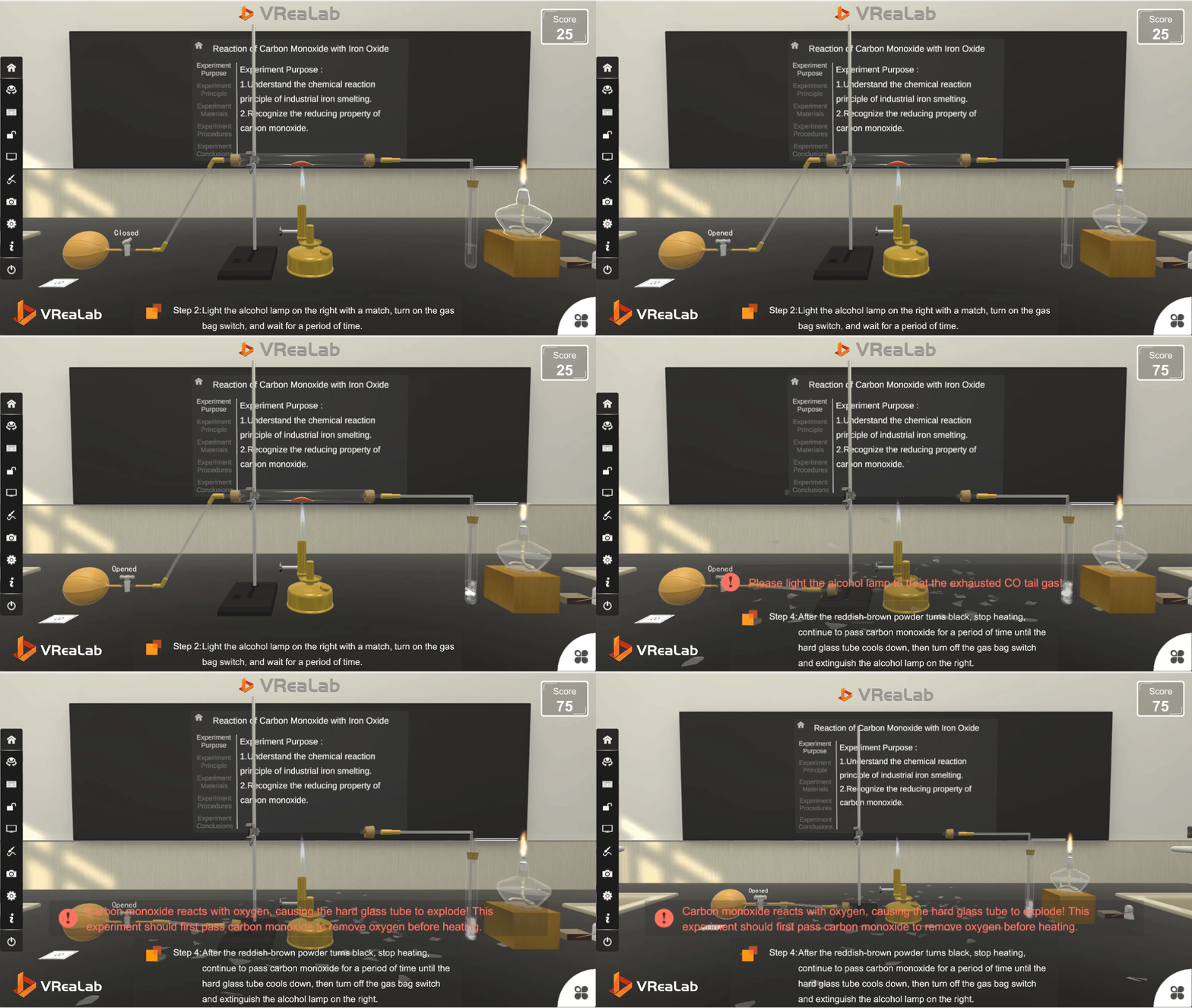
The reaction of carbon monoxide with iron oxide is a classic case. It demonstrates the reducing property of CO and the principle of industrial iron smelting, but it involves a toxic gas, a 1000-degree flame, and a strict tail-gas treatment procedure. In a physical classroom, one wrong sequence can vent carbon monoxide into the room. In the Virtual Lab, the reaction happens on screen: students ignite the alcohol blast burner, watch the reddish-brown powder turn black, and follow the correct shutdown order, while the software watches them back.
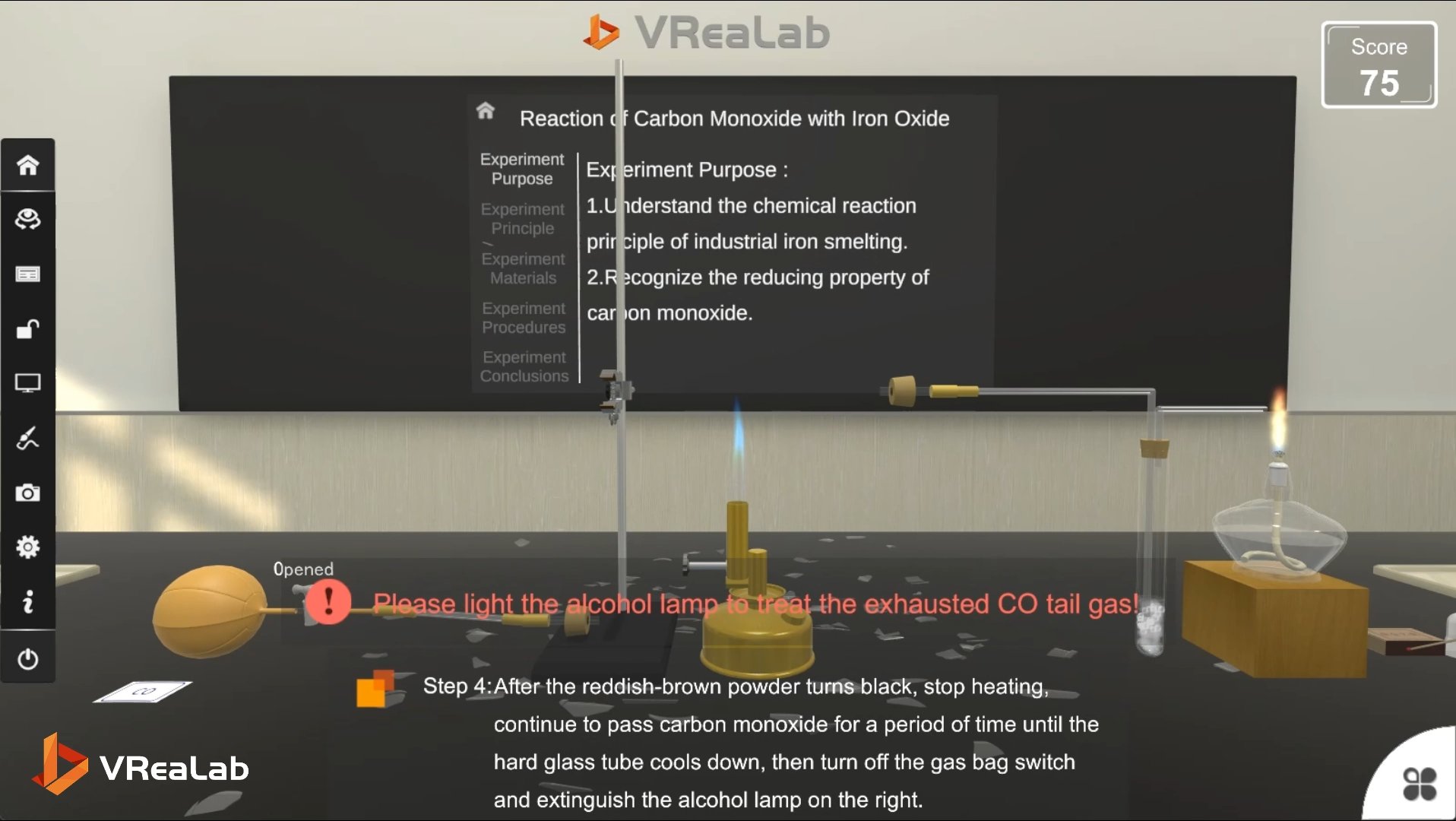
When the tail gas is left untreated, the software interrupts the experiment with a warning: light the alcohol lamp to burn off the exhausted CO before continuing.
The warning in Figure 1 is the key detail. Because a mistake in the Virtual Lab costs nothing, teachers can let students make it. The red alert teaches the reason for tail-gas treatment more memorably than any rehearsed caution, and the experiment simply waits until the student corrects the procedure. Safety rules stop being lines to memorize and become consequences that students have personally triggered, without any actual danger.
Making Invisible Reactions Visible
The second challenge is scale. Diffusion, molecular motion, and gas exchange happen far below what any classroom demonstration can show. The molecular motion module answers this with a microscopic view: two small beakers, one holding concentrated ammonia solution and the other phenolphthalein solution, are covered by a large beaker, and the stated purpose is to investigate that molecules are in constant motion. Students then switch to the microscopic layer and watch individual molecules drift, spread, and trigger the color change that macroscopic eyes can only infer.
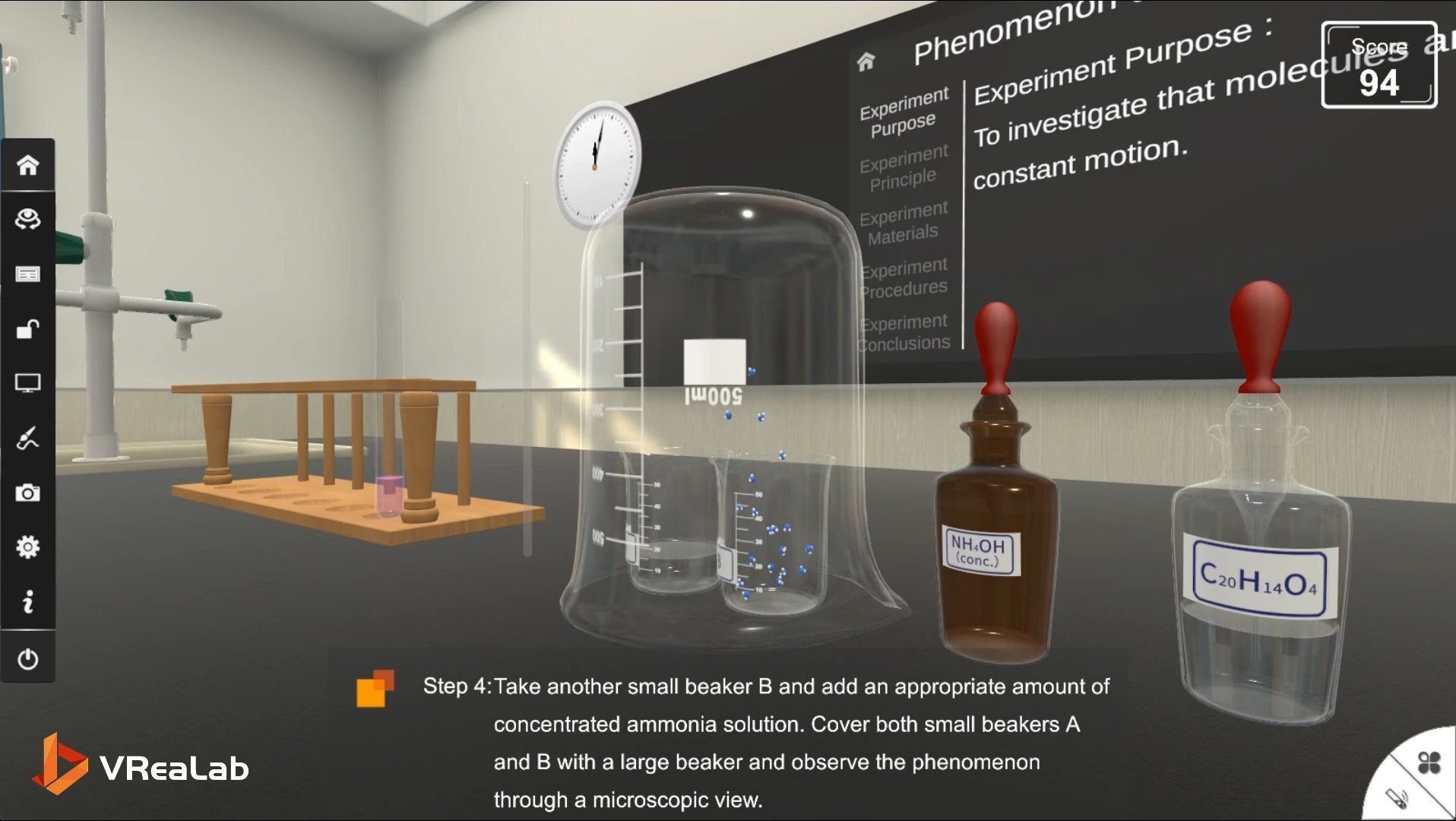
The microscopic view inside the covered beaker: individual molecules in constant motion, with the experiment purpose displayed on the blackboard.
This is what VR Chemistry Labs do that no physical setup can: they add a zoom level between the macroscopic phenomenon and the abstract equation. Students connect the color change they would see in reality with the molecular behavior that causes it, all inside the same Virtual Lab scene, at their own pace, with unlimited repeats.
Repeating the Unrepeatable
The burning of iron wire in oxygen lasts seconds. In a real classroom, half the students blink and miss it, and the gas jar cannot be refilled endlessly for replays. In the virtual version, students tie a match to the coiled iron wire, light it, and insert it into a bottle of pure oxygen with water reserved at the bottom. The wire blazes with brilliant sparks, and the scene can be reset in one click for the next observation or the next attempt.
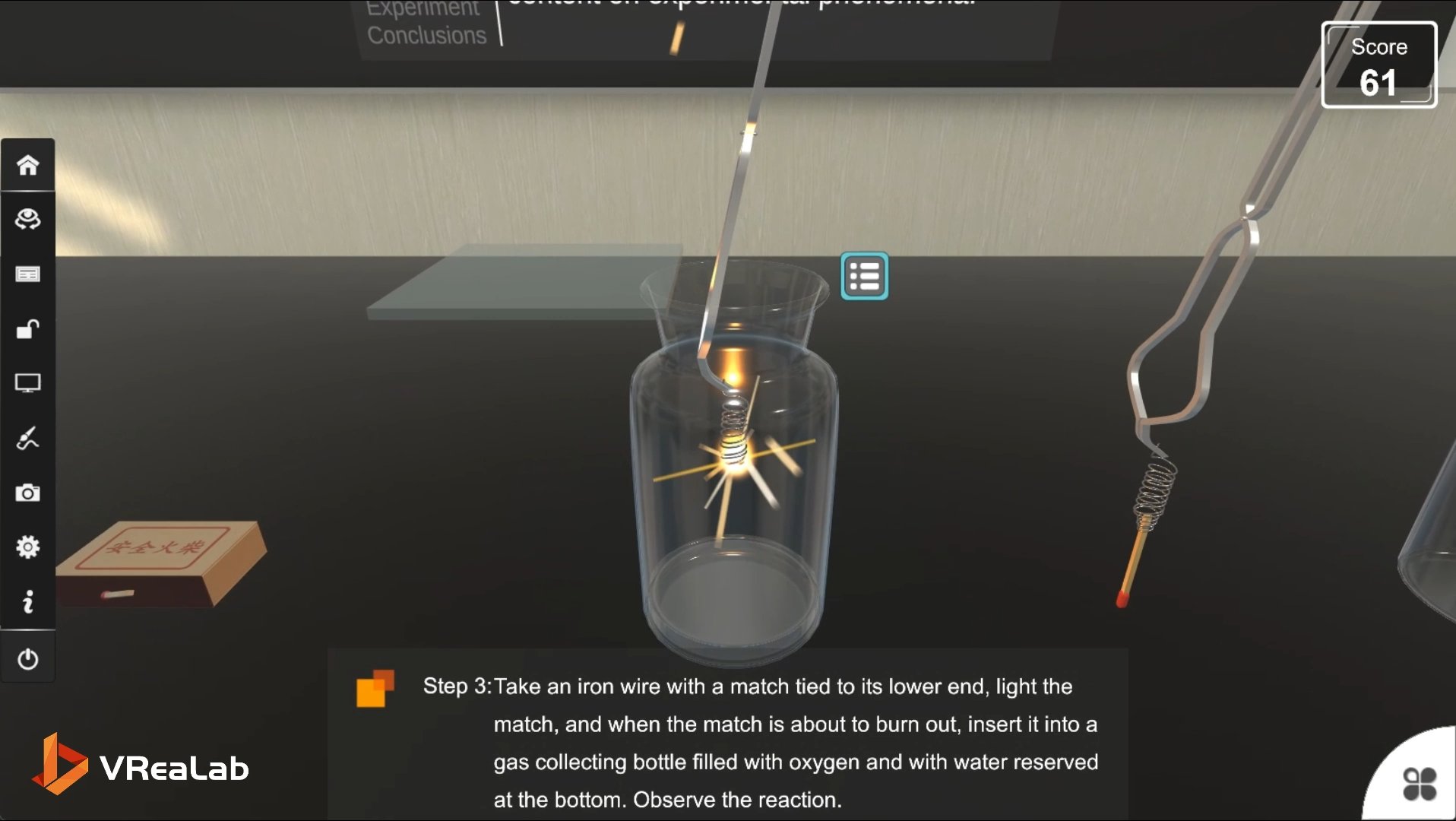
Step 3 of the iron wire experiment: the match is nearly burned out as the wire enters the oxygen-filled bottle, with water protecting the glass bottom.
The guided step shown in Figure 3 also matters. The software specifies the correct timing, inserting the wire just as the match is about to burn out, and the correct protection, keeping water reserved at the bottom of the bottle. Students who rush the timing simply watch a failed attempt and try again, which is how procedure is learned in reality. Because the Virtual Lab never runs out of oxygen bottles, iron wire, or matches, a class of forty can each perform the reaction five times in the period that one live demonstration would occupy.
Conclusion
Safe danger, visible micro-worlds, and repeatable demonstrations are not three separate products; they are one coherent promise. VR Chemistry Labs let junior high students attempt the experiments that matter, see the chemistry that hides, and learn from mistakes that harm no one. For a subject taught at the scale of atoms and the temperature of furnaces, that promise is exactly what the classroom has been missing.